Lockdown? Or is it perhaps meltdown?

Johannes Wessels
@johannesEOSA1

Halfway into a five-week lockdown it is appropriate to compile a kind of “balance sheet”. When the lockdown was announced, Pres Ramaphosa made it clear that protecting lives against Covid 19 was paramount: a position he reiterated when prolonging the lockdown.

For the ANC Government, all other considerations weigh less and may be sacrificed. Mutating from a supreme commander in military camouflage uniform rallying his troops to “kill the virus” to a pope like appearance during Easter sympathizing with the population for carrying the heavy cross, almost like Simon of Cyrene, Ramaphosa has been lauded all around as “bold” and “presidential”. The few voices that since the beginning have argued that severe restrictions that limit fundamental freedoms would fuel poverty and unemployment, were brushed aside as being both inhumane and wrong.
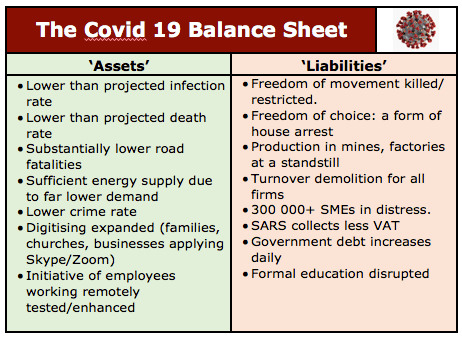
To date it is uncertain whether the lockdown, the wide application of Bacillus Calmette–Guérin vaccine in SA or any ther factor has contributed to the (still) low infection rate in South Africa. What is dead certain is that the economy (already in a critical condition prior to the appearance of Covid 19) has been rushed into ICU to a position close to the door where the dead are wheeled out to the morgue.

Read EOSA’s proposals on how Government can assist SMEs by cutting CIT and exempting those with a turnover below R2.5 million from VAT.

Government has, as yet, to indicate its estimates of the economic impact of the lockdown measures, e.g.:

  • the decline in VAT receipts;
  • the decline in CIT (and for sole proprietors, the decline in personal income tax);
  • the additional costs of demands on the UIF;
  • the additional costs of deploying the military and the police at the current levels;
  • the cost of measures to support the informal traders, small enterprises and other assistance measures to support businesses;
  • the support measures to assist businesses in the hospitality industry;
  • how these would impact on the budget deficit and what the implications are for government debt.
Continue reading “Lockdown? Or is it perhaps meltdown?”

The celebration of rampant incompetence

Johannes Wessels
@johannesEOSA1

As grotesque neon-light signboards shout their messages out in the darkness of night, the ANC’s signature of their quarter century of rule has been rife in evidence in the first weeks of 2020. No, not the good life of liberty that the movement had promised, but the embrace and celebration of rampant incompetence.

Nowhere was that more obvious than:

  • in the jubilation about matriculation results;
  • when senior well-decorated police officers didn’t know their right from their left at the funeral of Richard Maponya;
  • in both the presentation of and applause for the platitudes in Pres. Ramaphosa’s ‘January 8 speech’.

Matric results: better outcome than Bantu education?

Continue reading “The celebration of rampant incompetence”

30 years on: Is Ramaphosa preparing his version of FW’s “to-the-dustbin-with-ideology” speech?

Johannes Wessels
@johannesEOSA1

Thirty years ago (on New Year’s Eve 1989), FW de Klerk knew that the South Africa was on the verge of massive change. The combined debilitating effects of apartheid’s shackles on the economy (including sanctions) and the impossibility to continue with the disenfranchisement of the majority of the population, prompted him to prepare his watershed 2 February 1990 speech in which he effectively pulled the plug on apartheid.

Will the combined negative legacy of the transformational drag on the economy and the implosion of state-owned enterprises (SOEs) prompt Ramaphosa to discard the ANC’s ideological stance in 2020? 

Continue reading “30 years on: Is Ramaphosa preparing his version of FW’s “to-the-dustbin-with-ideology” speech?”

Ramaphorian air spray no longer conceals the stench of a decaying economy

Johannes Wessels
@johannesEOSA1

President Cyril Ramaphosa’s commitment to revitalise the economy reminds one almost of president Zuma’s commitment to combat corruption: spraying air freshener to divert attention from a rotting carcass.

Read instructions on the can for effective application…

The person who promised in his New Dawn manifesto a growth rate of 3% in 2018 through “an unrelenting focus on economic growth” has delivered after 18 months a growth rate of 1.3% in 2018 and negative growth up to date for 2019. Some people would say low growth is still growth, however economic growth below the population growth rate impoverishes the population.

He presides over an economy in worse shape than when he assumed power: one characterised by:

Continue reading “Ramaphorian air spray no longer conceals the stench of a decaying economy”

Xenophobia: the solution is not better border control, but a change in economic policy

Johannes Wessels
@johannesEOSA1

Is Donald Trump advising the ANC and the DA?  Bashing (illegal?) immigration is a key pillar in both these campaigns and both parties are as wrong and misguided as Trump on this subject, trying to address consequences and ignoring the cause.

The ANC election manifesto promises the party will ensure “those who come to South Africa do so legally and that the country knows what they do while they are in the country”. It will take “tough measures against undocumented immigrants involved in criminal activities in the country or in cross-border crimes, including those involved in illegal trading and selling adulterated food in townships and villages”. 

It is hard to spot the difference when the DA’s Musi Maimane says “securing our borders is not simply about keeping people out. It is about ensuring that all migration occurs legally and knowing who has entered the country. It is about being able to plan ahead and make sure our budgets can stretch to cover all they need to cover. It is about making it easier for those who want to enter South Africa legally – because we want legal, law-abiding people to bring their skills here and help grow our economy – but making it impossible for those who want to enter illegally.”

the fault line of prejudice …

Continue reading “Xenophobia: the solution is not better border control, but a change in economic policy”

SA Government values mice as cheese factory managers more than productive knowledge

Almost 50 years ago, in 1970, Alvin Toffler in Future Shock wrote: Knowledge will become a more important driver of growth than capital or labour.

The two parties that then dominated the South African landscape did not hear the message: they had ideological ear wax and blinkers.

Inside the country the National Party wasted an opportunity to revamp and refocus Bantu education. In the words of Verwoerd, Western education was “of no avail for training which has as aim absorption in the European community while he cannot and will not be absorbed there. There is no place for him in the European community above certain forms of labour. However, within his own community all doors are open… For that reason, it must be replaced by Bantu Education. In the Native territories where the services of educated Bantu are much needed, Bantu education can complete its full circle, by which the child is… developed to his fullest extent in accordance with aptitude and ability…”  

The harvest: the Soweto 1976 riots. 

In exile and underground the ANC under the SACP influence believed labour was all important and capital from hell and that labour time was all that gave value to a product or service – a belief still voiced in 2016 by their leader.  (That statement was never repudiated by Ramaphosa or any leader in the ANC.)

The 80’s introduced “liberation before education”, the burning of schools and the intimidation of teachers and after 1994, the ANC government ensured SA’s education system became one of the worst performers in the world at the highest cost (% of GDP).  

The harvest:  a suffocating labour regime that leaves SA businesses hamstrung (considering productivity levels) and that promotes low-employment business practices.

Whilst race remains an important indicator to measure inequality, trying to always explain situations from a racial perspective often implies ignoring solutions with better potential than betting on race.  The ANC is not alone in operating with racial blinkers. Musi Maimane’s statement that race remains “the only consistent measure we have at this point for measuring inequality”, is simply wrong.

So is Ramaphosa when he offered protection for Maimane for that remark.

And so is Chris Bateman’s editorial to a recent Bloomberg report on Johann Rupert’s comments during the Chairman’s Conversation when he wrote: “What he (Rupert)  misses in his strong argument that Eskom and other SOEs are the real monopolies, is that White Monopoly Capital, like all effective propaganda, is built on the fundamental truth that our Gini-coefficient runs on racial lines – due to the architecture of apartheid.

There are non-racial measure tapes available… and some measure more accurately than race.  After a few examples where the ANC government chose cadres rather than knowledge, the focus will fall on one non-racial explanation for income and wealth inequality.

Continue reading “SA Government values mice as cheese factory managers more than productive knowledge”