The Chairman’s Conversation: Triggering a Groot Trek of productive knowledge out of SA?

Johannes Wessels

@johannesEOSA1

Stark dividing lines on the economy and the future of the country were drawn during the Chairman’s Conversation when Johann Rupert of Richemont, Remgro & Reinet was interviewed by Given Mkhari of the MSG Afrika Group.  The Black Management Forum called for controlling the “levers of legislation to determine what happens with capital, opportunities and business prospects” (state control of the economy) with Rupert hinting that “it would be quite easy to lose interest: South Africa has one last chance…

On talk radio, news websites and social media reactions rolled in, many calling Rupert “racist”, “paternalistic” and even “an arrogant ignorant” whilst others concurred with his comments about the young chasing BMWs and immediate satisfaction,  rather than patiently building their businesses and wealth.

The event and the reactions thereto is far more than a storm in a tea cup and one that the whole business community should take note of, as well as every company and politician that had attended the recent Investment Summit. 

The contours of the Chairman’s Conversation, the few comments from the floor and the tsunami of social media condemnation reminded me of a period in world history that had changed and influenced (almost) everything since then. My sense is that both Rupert and the BMF reckon South Africa is at the brink of society-shaking change as well.  That change does not necessarily bode well for the future of South Africa…

Continue reading “The Chairman’s Conversation: Triggering a Groot Trek of productive knowledge out of SA?”
White Monopoly Capital: astute reverse double somersault or a Janus performance?

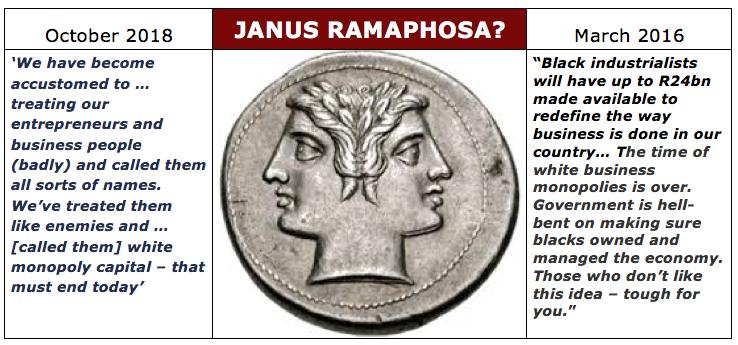
Is the presidential acknowledgement of entrepreneurs as heroes and not villains the equivalent of Pope John Paul II’s admission that the church was wrong to condemn Galileo for endorsing a helio-centric view? If so, it is one of the most astute political reverse double summersaults. As deputy-president Mr. Ramaphosa himself sung heartily the “Down with White Monopoly Capital” song in the Zuma choir.

Janus Ramaphosa

Does the comment during the dinner of the Investment Summit really signal the dawn of economic freedom or was it merely a modern manifestation of Janus? Will the future reveal a Ramaphosa butterfly that was an ugly caterpillar under Zuma or is the two-mouths-two-messages the real reality?

The first requirement to assess future options is a proper understanding of the present. Let us explore that by assessing the ANC Government’s (and Ramaphosa’s) views on SMEs:  does it indicate an embrace of private initiative or something else?

Continue reading “White Monopoly Capital: astute reverse double somersault or a Janus performance?”

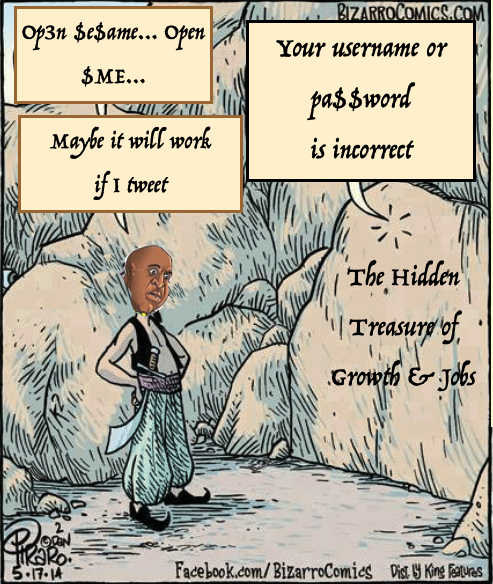
SMEs not the magic “Open Sesame” that unlocks growth & jobs (1)

Johannes Wessels
@johannesEOSA1

Within a week of his inauguration as Finance Minister, Tito Mboweni muttered the magical “Open $e$ame” words that, according to legend, will reveal the treasures of economic growth, job-creation and the eradication of inequality.

open-sesame-your-uservame-o-password-are-ectu-open-segame-26200568

Addressing the Association of Black Securities and Investment Professionals, Mboweni said “to get the economy performing, government needed to create an environment which allowed small and medium enterprises to operate at an optimum level.

“We must think in particular how to support small and medium enterprises. In Germany the economy is driven by the hidden champions that are small and medium enterprises,” Mboweni said.

The religious preacher built his sermon on the inspired text of the syncretic National Development Plan, chapter 3 verses 115 & 139:

Continue reading “SMEs not the magic “Open Sesame” that unlocks growth & jobs (1)”

Economic freedom globally up but SA tumbles down

ECONOMIC FREEDOM in South Africa deteriorates rapidly. The country has tumbled 12 places and is now firmly embedded in the bottom half of the 162 countries and territories evaluated in the Economic Freedom of the World: 2018 Annual Report. This report by the Fraser Institute confirmed SA’s decline from position 82 to 94 due to anti-freedom policies and practices.

In 2003 SA almost made it into the most-free quartile ranking gaining position 45.  Now the country is a 3rd quartile fixture, being three consecutive years in the bottom half.

The Economic Freedom of the World Report  is the world’s premier measurement of economic freedom, evaluating and ranking countries in five areas: size of government, legal structure and security of property rights, access to sound money, freedom to trade internationally and regulation of credit, labour and business. (See full report).

Continue reading “Economic freedom globally up but SA tumbles down”

Pro-poor LED fails our cities, towns & the poor: Enterprises of the right kind generate city growth

Johannes Wessels
@johannesEOSA1

There is an intriguing symbiosis between cities and towns on the one hand and enterprises on the other. As the world population urbanise, so are business activities.

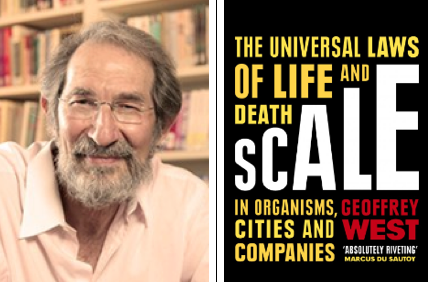
Physicist Geoffrey West in his “Scale:  The Universal Laws of Life, Growth and Death in Organisms, Cities and Companies” says based on city growth one can state precisely what will happen with the number of businesses in that city: a doubling of population does not require a doubling of grocery stores or filling stations, economies of scale kick in in a predictable manner. The reverse is also true.

Geoffrey West & Scale

Unfortunately, South Africa’s economic and enterprise development policies and strategies ignore these predictable realities. In addition, LED plans by municipalities in the main demonstrate a lack of understanding of what drives development.

Continue reading “Pro-poor LED fails our cities, towns & the poor: Enterprises of the right kind generate city growth”

Are our enterprise policies shaped by obsessions? Paradigm paralysis (2)

Ramaphosa’s Manifesto – “A New Deal” – envisages the “massifying” of black enterprises to promote growth and job creation. It is shaped – like the National Development Plan – by the paradigm of SMEs as prime agents for growth and jobs. As the belief in the curative effects of bloodletting – it was the general consensus – acted as a barrier that prevented the consideration of alternative treatments, the belief in SMEs obscures evidence that net job creation is largely independent of firm size.

Convictions, one must remember, do not necessarily yield to evidence.

Masaai Mara crossing

For the creation of several hundred thousand successful businesses (or would “massifying” – Ramaphosa’s term – imply businesses by the million?) there needs to be at least a similar number of entrepreneurs with effective business skills and plans for these businesses to have a chance of survival.

But for a business to succeed one needs other ingredients than mere entrepreneurial aptitude and astute management: it requires support from customers and clients. Successful “massifying” of new businesses would therefore depend on a prior (or at least simultaneous) mushrooming of the spending power of existing consumers and/or the “massifying” of consumers.

On that, the New Deal is silent… Could a 2016 warning about economic transformation hold the explanation?

Continue reading “Are our enterprise policies shaped by obsessions? Paradigm paralysis (2)”