

Nel and Rogerson (2016) reviewed Local Economic Development (LED) policy and practice in South Africa. They reported that results have been modest despite the significant support for nearly 20 years put into applied local economic development. They suggested that a potential over-focus on pro-poor local economic development at the expense of simultaneously working with the private sector on pro-market interventions, could be a stumbling block to the potential success of LED.
Mason (2018) stated that poverty is a multifaceted phenomenon and the condition of poverty often entails one or more of these realities: a lack of income (joblessness); a lack of preparedness (education); and a dependency on government services (welfare).
I asked if our research on enterprise dynamics that reported a wide range of regularities in the enterprise structures and dynamics of South African towns and municipalities (some of which have already been discussed here) could help to shed light on a question whether a pro-poor LED stance might be justified.
 Because of high unemployment and poverty levels, all South African municipalities have been tasked to promote local economic development (LED) as part of their integrated development plans (IDPs). Various central and provincial government departments, organizations such as SALGA as well as consultants provide LED guidance and support to the municipalities. And academics do research on LED and small towns in South Africa and publish their results in scientific journals. Yet, given the above, there is an aspect that really puzzles us.
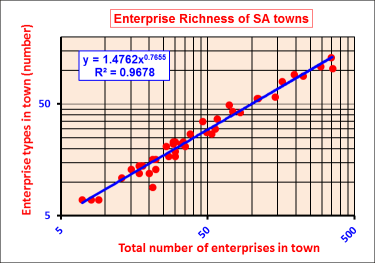 Log-log relationships which endured over 70 years were recorded and these relationships raise important issues about the nature of entrepreneurship and its dynamics in different-sized South African towns. The figure shows such a relationship that covers a range of villages with fewer than 10 enterprises to towns with 350 enterprises.
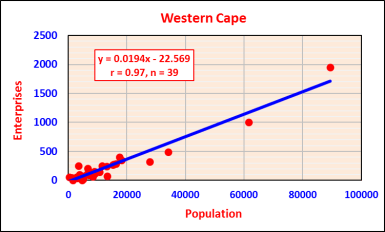 Orderliness in enterprise development in South African towns has been observed as statistically significant correlations between different characteristics of South African towns. One of the first correlations noted was a statistically significant positive relationship between the population of South African towns and the number of their enterprises. This was observed in the Free State, the Northern Cape, the Western Cape (see graph) and the Gouritz Cluster Biosphere Reserve. In fact, towns in the Eastern Cape Karoo exhibited such relationships over a period of a century. One can conclude the relationship is ubiquitous in South Africa.
 EOSA
EOSA 