In his weekly letter from the president’s desk (13 April), pres. Ramaphosa lamented the vandalism that had caused the demolition of schools, describing it as “a great indictment of our society”. He pointed to the despicable implications: “When lock-down is lifted and learning resumes, thousands of our children will have no school to return to, depriving them of the right to education…”
The irony of his words is that the government is currently the vandal-in-chief. The damage done to schools in the president’s lament of four months ago is dwarfed into insignificance when compared to the destruction its lock-down strategy is inflicting on South Africans.
The sheer magnitude of their destruction boggles the mind. They have:
Day 132 after registering the first 100 Covid infections in SA made it clear how unsuccessful the lock-down has been: South Africa’s number of Covid infections/ 10 000 of the population despite the world’s harshest lock-down with a curfew, mandatory face masks and an alcohol ban passed that of a country that has never implemented lock-down, never made face masks mandatory and would have continued to buy South African wines were it not for the SA government that had banned the transport (and therefore export) of wine. (Figure 1)
Like that legendary village in Gaul ( home of Asterix and Obelix) held out against the might of Caesar’s Rome to maintain local culture, Sweden kept the constitutionally protected rights of its citizens intact (freedom to move, associate and work) whilst most of the world capitulated with lock-down measures before the might of fear brought about by flawed modelling of the Covid threat.
South Africa’s government early on sacrificed these rights, transforming its citizens to subjects, all “to ensure that the infection curve would be flattened to get ready for the Covid storm”. Figure 1 clearly shows how the curve was flattened, but today we know that it was not utilised to ensure Covid-ready hospitals with well-motivated staff serving sufficient beds in ICUs and care centres equipped with ventilators and required equipment.
The BBC had shown the world that the “flattening of the curve” was not used for that, at least not in the Eastern Cape. The Minister of Health, Zweli Mkhize, however disputed the BBC findings, stating that, apart from the fact that the EC hospitals:
should follow medical waste protocols;
require more beds;
needed more nursing staff;
had to procure more ventilators, and
should get rid of blood on the floor and the rats,
the province was ready for the Covid crisis.
Easier to exterminate hospital rats than tender rats?
Mkhize made no mention that these problems were probably linked to the government’s continued feeding of the tender rats.
Quicker than what a minibus taxi can skip a traffic light, Andile Ramaphosa of Bosasa fame had convinced FNB to sponsor a R6 million contract to install Perspex shields and sanitise equipment in Gauteng taxis. He claims he is not personally benefiting from the contract awarded to SDI Force (an NGO).
The perception of numerous commentators and business leaders that South Africans should mobilise behind president Cyril Ramaphosa, Pravin Gordhan and Tito Mboweni to support the “good guys” in the ANC to ensure an economic recovery, is not only simplistic: it is utterly naive.
It is also not new. It is a rehash of the theme of the 1970s when the
National Party was assessed as comprising good guys (the verligtes) and bad guys
(the verkramptes)
with many commentators arguing the case to support the verligtes. The person
who eventually took the quantum leap with a definite break with apartheid (F W
de Klerk) was not counted amongst the verligtes. He was seen as rather
conservative and a natural choice to chair the Ministerial Council for White
“Own Affairs”.
Verlig-verkramp focused primarily on how Nationalist MPs were oriented on apartheid. That analysis had no eyes for another fundamental division: The PW Botha approach with the security structures of the military and national intelligence as key players versus those who preferred a civil-oriented approach with parliament in the fulcrum. De Klerk belonged to the latter faction. Botha and the securocrats had commenced talks and interaction with both Nelson Mandela (then in Pollsmoor) and the ANC in exile, but De Klerk was largely uninformed and excluded from these discussions.
Playing whilst the resource base is shrinking…
Verlig-verkramp was an insufficient perspective to detect the person who
would make the decisive break with apartheid.
Now, many commentators and business leaders still cling to the hope for action and clear policy direction, contrary to what is happening in reality. The hope that “Ramaphosa knows what is required” is based on viewing the ANC as comprising a “good ANC” and a “bad ANC” and that the good guys will restore the country to a golden growth path. Treasury’s document on economic policy is clung to as a lifebuoy.
The good guys are
supposedly led by Ramaphosa, Mboweni, Pravin Gordhan and Gwede Mantashe, with
the bad guys
represented by Ace Magashule, Faith Muthambi, Supra Mahumapelo and others.
This cowboys-and-crooks-perspective is naïve. It also fails on at least four grounds.
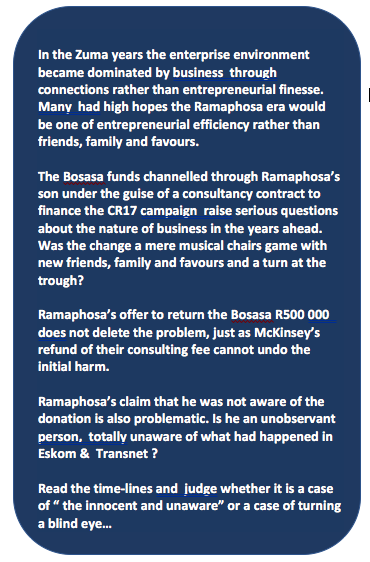
Pres Cyril Ramabosasa’s written statement to the Speaker that he was not aware of a R500 000 donation by a company with large contracts with government to finance his acrimonious campaign for the leadership of the ANC, confirms he is a person with not the faintest interest in detail and quite satisfied to accept that it is “twelve o’clock and all’s well…”
It is the third time in a year that he denied any knowledge of wrongdoing at the time of the events and for a very long time afterwards. In baseball, it would have been the dreaded Strike Three and out.
But this is South African politics. And with a parliamentary system where the ANC as majority party has accepted as norm the precedent of a president that answers with a “I don’t know” and thereby dodging the crux of parliamentary questions, it will not be “Strike Three” for Ramabosasa.
The two prominent issues about which Ramaphosa also had
denied any knowledge of wrong-doing, deal with:
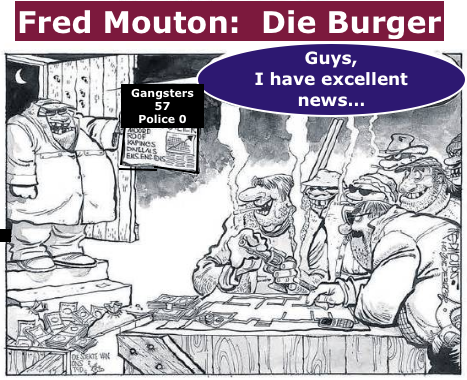
SA is increasingly deteriorating into a combination of the Wild West and a Mafia state with Government incapable of keeping crime in check. Minister Beki Cele admits “the ball was dropped” but remains adamant that “(w)e haven’t reached a state of lawlessness in South Africa and we won’t”.
The South African population begs to differ: Crime pays… and quite handsomely as well.
The returns on crime far exceeds returns on long-term investment in blue chip stocks. South Africans’ trust in and reliance on the police is scarcer than icebergs in tropical oceans. And inefficient policing doesn’t only kill the economy: it kills justice as well.
The anger because of billions lost through corruption and state capture comes at an enormous opportunity cost. The focus on the Zuma-Gupta-axis acts as blinkers that prevent a focus on the massive cost of adhering to failing economic policies and strategies – a cost far greater than the billions swindled away through corruption.
Three figures show clearly that the economic malaise is much deeper than the damage caused by corruption parasites and that the impact of poor policies started long before corruption landed under Government privilege at Waterkloof. Blaming the economic ills of South Africa on State Capture is a massive over-simplification.


 EOSA
EOSA 