SA lost 83 000 companies in the financial & business sector in 10 years

Johannes Wessels@

@johannesEOSA1

The landscape of incorporated South Africa in the financial and business services sector has changed dramatically: in 2007 a total of 222 532 companies in this sector submitted tax returns, but SARS Company Income Tax (CIT) data show by 2016 this figure had shrunk to 139 664: a 37% decline.

The CIT data base records a decline by almost 83 000 incorporated firms.  What happened?

This sector includes banks, money lenders, short term insurance firms and independent brokers, investment advisors, business consulting firms as well as real estate services. Figure 1 shows how the number of firms were relatively stable from 2007 to 2010 before a rapid decline before stabilising again from 2014 onwards.

Continue reading “SA lost 83 000 companies in the financial & business sector in 10 years”

SA enterprise sector critically ill

Johannes Wessels

@johannesEOSA1

The formal South African Enterprise Sector is critically ill. Were the company tax returns of the 768 000 companies combined and submitted as that of a single entity (say SA Amalgamated (Pty) Ltd) there would not have been any Company Income Tax (CIT) payable to SARS for three consecutive tax years.

SARS data on Company Income Tax (CIT) confirms the private sector is in a dismal state. In the tax years 2014 – 2016 assessed joint losses of all companies surpassed joint taxable income by R445 billion.

SARS data on CIT from 2007 to 2016 on assessed CIT returns bring the following to the fore (see Figure 1 below):

Continue reading “SA enterprise sector critically ill”

Ten wasted years: Preferring “Dumbing Down” to “Productive Knowledge”

Johannes Wessels

@johannesEOSA1

TEN WASTED YEARS…  Tito Mboweni’s colloquium “to think outside the box about economic growth” is akin to closing the stable door after the racehorse had not only bolted, but already won a race elsewhere. Scavenging in the ANC dustbin of rejected advice, Mboweni picked Harvard economist Ricardo Hausmann as advisor, knowing well Hausmann’s advice on productive knowledge had been flatly ignored by the ANC Government since 2008.

Hausmann considers productive knowledge as the key factor that separates successful countries from unsuccessful ones. A lack of productive knowledge therefore retards economic growth and development.

From 1990 to 2003 South Africa lost 7% of its professionally qualified people, predominantly high-skilled whites.  After some stability that came during the high growth Mbeki-Manuel years the exodus was re-triggered by the growing ineptitude of an administration that radically transformed departments and state-owned enterprises (SOEs) into little more than facades.

The police service, SAA, Transnet, the NPA and municipalities are some examples where cadre deployment trumped productive knowledge. The result:

  • At township level, the disgruntled resorted to service protests.
  • At professional level, they packed their bags and headed to the emigration counter with highly skilled blacks now outnumbering their white counterparts, bound in solidarity by a deep non-racial gatvolheid in the slide into corruption, lawlessness, dismal public services and the undermining of property rights. 
  • At investor level, South African businessmen have emigrated through FDI:  fixed investment by South Africans abroad exceed fixed investments lured to our shores.
  •  

Make BEE growth compatible

Continue reading “Ten wasted years: Preferring “Dumbing Down” to “Productive Knowledge””

State-owned enterprises: The Parable of the Talents

Johannes Wessels
@johannesEOSA1

Total disregard for governance and the basic enterprise principle of return on investment emerged from testimonies before the Zondo Commission, confirming the ANC approach to enterprises and corporate governance considers productivity, accountability and skills as immaterial. Ideological nepotism and cash-for-cadres dominated appointments and decisions. 

Both Government and the ruling party cannot submit a defence of “we were not aware…” about the dire state of Eskom, Transnet, the SAA or the SABC.  Warnings against the mismanagement of state monopolies and the stifling effect of State-owned enterprises (SOEs) on the economy had been voiced over and over again, also in parliamentary standing committees. There the ANC majority vote repeatedly treasured party and cadre loyalty higher than their oath to keep the executive accountable. 

The testimony of Barbara Hogan as well as the annual reports to Parliament by Transnet, Portnet, SAA, Eskom, Sefa and others reminded me of the parable of the talents as recorded in Matthew 25: 14 – 30. Continue reading “State-owned enterprises: The Parable of the Talents”

SMEs not the magic “Open Sesame” that unlocks growth & jobs (1)

Johannes Wessels
@johannesEOSA1

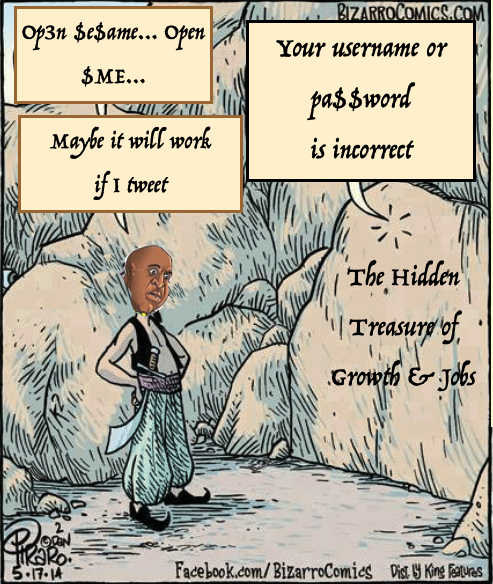
Within a week of his inauguration as Finance Minister, Tito Mboweni muttered the magical “Open $e$ame” words that, according to legend, will reveal the treasures of economic growth, job-creation and the eradication of inequality.

open-sesame-your-uservame-o-password-are-ectu-open-segame-26200568

Addressing the Association of Black Securities and Investment Professionals, Mboweni said “to get the economy performing, government needed to create an environment which allowed small and medium enterprises to operate at an optimum level.

“We must think in particular how to support small and medium enterprises. In Germany the economy is driven by the hidden champions that are small and medium enterprises,” Mboweni said.

The religious preacher built his sermon on the inspired text of the syncretic National Development Plan, chapter 3 verses 115 & 139:

Continue reading “SMEs not the magic “Open Sesame” that unlocks growth & jobs (1)”

Turning ad hoc-decisions into “add havoc” decisions: Updated prospectus shows SA has much “emerging” to do…

If the Ramaphosa quest for pursuing economic growth and restoring full investment status for South Africa was packaged as a new venture in January it would have received substantial interest. In light of the tsunami of promises about FDI since then, it may be time to look at an updated “prospectus”.

Indicator: Economic growth is the highest priority

In his “New Deal” Ramaphosa promised to keep “an unrelenting focus on growth”. He stated: “We must be bold and determined. We should be targeting 3 percent GDP growth in 2018 rising to 5 percent growth by 2023.”

Prospectus update:

Screen Shot 2018-07-26 at 6.01.54 PM
The Messenger (25 July 2018)

Continue reading “Turning ad hoc-decisions into “add havoc” decisions: Updated prospectus shows SA has much “emerging” to do…”