

Whilst the downgrading of investor status by Standard & Poor and Fitch already drives foreign investment away from South Africa with capital flight from the JSE, at the local front ineffective crime prevention by the Government is one of the largest disincentives for enterprise investment: a million people would have considered home-based businesses were it not for criminality. Continue reading “If you thought the S&P and Fitch downgrades scare investors away… Government’s security & protection deficit prevents a million local would-be entrepreneurs from investing”
Blog
 Because of high unemployment and poverty levels, all South African municipalities have been tasked to promote local economic development (LED) as part of their integrated development plans (IDPs). Various central and provincial government departments, organizations such as SALGA as well as consultants provide LED guidance and support to the municipalities. And academics do research on LED and small towns in South Africa and publish their results in scientific journals. Yet, given the above, there is an aspect that really puzzles us.
 With Moody’s soon to announce their assessment of SA’s credit risk, Finance Minister Malusi Gigaba made it clear that a white minority was controlling the economy through a monopoly and that was now to change. Gigaba, speaking mostly in isiZulu, said “The economy is controlled by a minority; they are a monopoly. There are a lot of companies owned by very few people and the services and products on offer enrich these few people.” (Gigaba: It is time to put us first ).
Addressing an ANC Youth League event in Pinetown, Gigaba remarked that there was an agreement in 1993 that white people would continue to have a say in the economy. The ANC stayed committed to this, “but now has come a time for change. It is time to put us first.” Continue reading “If monopolies are the problem, start dismantling the worst: the State-owned Enterprises”
In two recent publications in the South African Journal of Science, we explored the enterprise richness, defined as the number of different enterprise types, of South African towns:
Enterprise richness as an important characteristic of South African towns; and
The enduring and spatial nature of the enterprise richness of South African towns
Remarkable and enduring regularities were observed between the number of enterprise types and the total number of enterprises in towns.
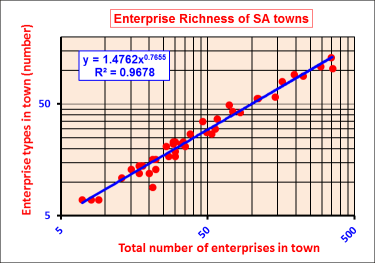 Log-log relationships which endured over 70 years were recorded and these relationships raise important issues about the nature of entrepreneurship and its dynamics in different-sized South African towns. The figure shows such a relationship that covers a range of villages with fewer than 10 enterprises to towns with 350 enterprises.
Continue reading “Of enterprise richness in South African towns”

One would expect Malusi Gigaba as new Minister of Finance to consider avoidance of further down-grades by rating agencies as his top priority. Policy confusion and instability coupled with growth unfriendly strategies already caused the Fitch and the Standard & Poor downgrades. However, Gigaba’s comments yesterday indicated that he is more concerned about growing black owned enterprises than about growing the economy or receiving value for public money. Continue reading “With Gordhan out of the way Gigaba seems keen to embark on an anti-growth and anti-poor strategy”
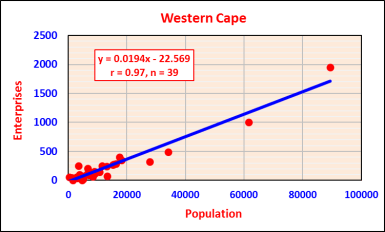 Orderliness in enterprise development in South African towns has been observed as statistically significant correlations between different characteristics of South African towns. One of the first correlations noted was a statistically significant positive relationship between the population of South African towns and the number of their enterprises. This was observed in the Free State, the Northern Cape, the Western Cape (see graph) and the Gouritz Cluster Biosphere Reserve. In fact, towns in the Eastern Cape Karoo exhibited such relationships over a period of a century. One can conclude the relationship is ubiquitous in South Africa. Continue reading “Of people and enterprises in South African towns”
 EOSA
EOSA 