

Johannes Wessels
@johannesEOSA1
Pres Ramaphosa’s announcement that four special ambassadors – including well respected Trevor Manuel – are to roam the globe in an aggressive pursuit of foreign investment “… like a pack of lions”, appears to be premature. It would have helped these ambassadors if they could have had a better story to tell than one of a business environment with stagnating profitability and growing losses where:
- only 25% of firms have earned sufficient to be liable for company tax;
- firms with a taxable income below R10 million decline at a rate of 31 per week;
- a mere 635 companies are responsible for 77% of company tax;
- from 2009 to 2015 company losses as submitted to SARS increased by 85% and for the last two years were higher than the taxable income assessed.
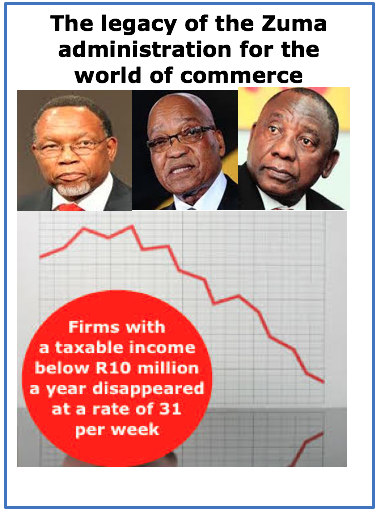
SARS data for tax years 2009 to 2015 (for the latter 95.4% of company tax returns have been assessed) as indicators for the health of the South African enterprise landscape, show the business devastation of the Zuma administration (5 with Motlanthe and 4 with Ramaphosa as deputy). This administration, responsible for mismanaging the macro-environment and overseeing the collapse of the police force and education quality and a rise in crime and corruption, critically damaged the enterprise environment.
Continue reading “Investment ambassadors can try, but SA company losses exceed taxable income”
 Because of high unemployment and poverty levels, all South African municipalities have been tasked to promote local economic development (LED) as part of their integrated development plans (IDPs). Various central and provincial government departments, organizations such as SALGA as well as consultants provide LED guidance and support to the municipalities. And academics do research on LED and small towns in South Africa and publish their results in scientific journals. Yet, given the above, there is an aspect that really puzzles us.
 Log-log relationships which endured over 70 years were recorded and these relationships raise important issues about the nature of entrepreneurship and its dynamics in different-sized South African towns. The figure shows such a relationship that covers a range of villages with fewer than 10 enterprises to towns with 350 enterprises.
 EOSA
EOSA 