Creating jobs and reducing poverty: why not enable the informal sector properly?

Author: Frederick Fourie

President Cyril Ramaphosa aims to set the country on a new path of growth, employment and transformation. Key to this are action plans for employment creation, to be deliberated at a jobs summit.
The South African Informal Sector: Providing jobs, reducing povertyA new edited volume, published by HSRC Press, flags the importance of explicitly addressing the informal sector in such initiatives, given the key role it plays in providing paid employment and reducing poverty. The book is based on research done in the Research Project for Employment, Income Distribution and Inclusive Growth (REDI3x3).

This research shows unambiguously that the informal sector is an important source of employment (and of paid employment), with a growing propensity to employ. Regrettably, for many decades the sector has remained forgotten or, at best, in the margins of economic analysis and policy consciousness. Many policy makers appear to group it together with formal SMMEs. Such an approach risks missing key elements of the ‘forgotten’ world of informal enterprises – their potential, the constraints they face, their particular vulnerability, and the policy support they need to be viable and self-standing.

How many jobs are created in the informal sector?

Continue reading “Creating jobs and reducing poverty: why not enable the informal sector properly?”


The folly of creating businesses whilst tolerating a criminal-friendly environment

Johannes Wessels
@johannesEOSA1

The South African enterprise world remains in critical condition despite numerous initiatives to cultivate entrepreneurship and new businesses since the real causes undermining its well-being are not addressed.  One of the fundamental causes for a struggling enterprise world is the fact that SA is more criminal-friendly than enterprise friendly.

Mooi River LEGO

We’ve seen that:

Comfortable in this paradigm, Government embarked on an interventionist road to transform the economy in accordance with its perceived reality. It launched a range of black enterprise incubation programs with massive grants, prescriptive procurement strategies, BEE, industry charters, interference with IP and a commitment to even expropriate without compensation.

Continue reading “The folly of creating businesses whilst tolerating a criminal-friendly environment”

Are our enterprise policies shaped by obsessions? Paradigm paralysis (2)

Ramaphosa’s Manifesto – “A New Deal” – envisages the “massifying” of black enterprises to promote growth and job creation. It is shaped – like the National Development Plan – by the paradigm of SMEs as prime agents for growth and jobs. As the belief in the curative effects of bloodletting – it was the general consensus – acted as a barrier that prevented the consideration of alternative treatments, the belief in SMEs obscures evidence that net job creation is largely independent of firm size.

Convictions, one must remember, do not necessarily yield to evidence.

Masaai Mara crossing

For the creation of several hundred thousand successful businesses (or would “massifying” – Ramaphosa’s term – imply businesses by the million?) there needs to be at least a similar number of entrepreneurs with effective business skills and plans for these businesses to have a chance of survival.

But for a business to succeed one needs other ingredients than mere entrepreneurial aptitude and astute management: it requires support from customers and clients. Successful “massifying” of new businesses would therefore depend on a prior (or at least simultaneous) mushrooming of the spending power of existing consumers and/or the “massifying” of consumers.

On that, the New Deal is silent… Could a 2016 warning about economic transformation hold the explanation?

Continue reading “Are our enterprise policies shaped by obsessions? Paradigm paralysis (2)”

Enterprise policies as untested as the practice of bloodletting: no wonder they fail (1)

Johannes Wessels
@johannesEOSA1

More than 3000 years the practice of bloodletting was applied to cure a range of illnesses: intense headaches, constipation, abdominal pain, boils or fever… It was administered by barbers (they had sharp blades) and later by qualified doctors. Some of the famous who received this treatment were Marie Antoinette (when giving birth in 1778 to her daughter Marie-Therese) and George Washington in 1799 on the day of his death when doctors drew about 40% of his blood in an attempt to cure him from a severe throat infection.

In Washington’s case one can only wonder to which extent the bloodletting had contributed to his death. In 1793 acute bloodletting by guillotine definitely caused the demise of Marie Antoinette.

Why did the bloodletting practice with its origins in ancient Egypt continue until a century ago as an esteemed medical practice? Two reasons:

  • The existing paradigm considered bloodletting successful, elevating it to the realm beyond questioning or doubt. It was practised by all the trained practitioners. It was therefore not questioned. Respect for specialist insistence on accepted practice re-enforces paradigmatic reign. Even after the description of the circulatory system by William Harvey in 1628 it took three centuries before the practice of bloodletting was largely abandoned as an unproven cure. One of the most striking examples of this blind acceptance of so-called “expert opinion” is the 1500 years that Greek physician Galen’s doctrines were revered. Galen said of one of his cures: “All who drink of this remedy recover in a short time, except those whom it doesn’t help who all die. It is obvious that it fails only in incurable cases.
Screen Shot 2018-06-02 at 9.41.29 PM
Continue reading “Enterprise policies as untested as the practice of bloodletting: no wonder they fail (1)”

Salary offer to civil servants: stark contrast to leadership in Botswana & the Netherlands

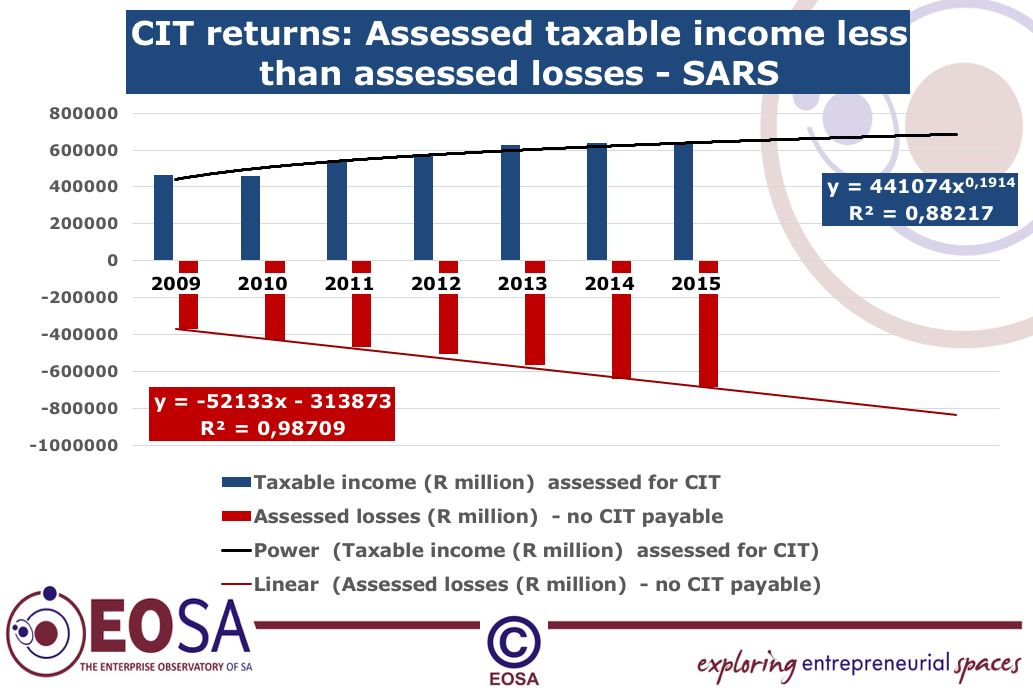
A higher than inflation salary increase for the public sector against the growing mountain of losses recorded in Company tax returns, does not signal an urgency for effective governance and economic stability to change from an environment where crime offers better returns than business. Important players in Government (and the ANC) appear not to grasp decisions and actions have systemic consequences.

SARS CIT assessments

South Africa’s public service salary bill consumes, according to Prof Jannie Rossouw of Wits Business School, about 45% of tax revenue. A 2017 OECD report found South Africa’s public service wage bill exceeded 14% of GDP: substantially higher than the benchmark of OECD and Emerging Market countries.

Continue reading “Salary offer to civil servants: stark contrast to leadership in Botswana & the Netherlands”

SA’s fight against unemployment: The importance of pet food, popcorn & detergents in the quest for growth

Johannes Wessels
@johannesEOSA1

On a sunny autumn morning in Bloemfontein I visited a business hand-picked by Government as a National Gazelle: one of the firms Government believes has the potential for massive growth and substantial job creation to attack the three-headed dragon of inequality, unemployment and poverty.

Popcorn & Flat Bread

The National Gazelles Programme is financed (well, by tax-payers) through SEDA (Small Enterprise Development Agency) and the Department for Small Business Development (DSBD). In the first phase 40 firms were identified in “10 priority industry sectors aligned with the National Development Plan and SEDA’s SME strategy”. The recruitment of the next batch is underway. (In enterprise literature, a Gazelle is defined as a company that grows by at least 20% per annum for 4 successive years)

Having covered  the decline in the number of formal businesses and how company losses now exceed taxable company income , as well as Government’s failure to create a business-friendly environment , the focus is now on the positive steps Government has taken to promote private enterprise.

Continue reading “SA’s fight against unemployment: The importance of pet food, popcorn & detergents in the quest for growth”