Enterprise policies as untested as the practice of bloodletting: no wonder they fail (1)

Johannes Wessels
@johannesEOSA1

More than 3000 years the practice of bloodletting was applied to cure a range of illnesses: intense headaches, constipation, abdominal pain, boils or fever… It was administered by barbers (they had sharp blades) and later by qualified doctors. Some of the famous who received this treatment were Marie Antoinette (when giving birth in 1778 to her daughter Marie-Therese) and George Washington in 1799 on the day of his death when doctors drew about 40% of his blood in an attempt to cure him from a severe throat infection.

In Washington’s case one can only wonder to which extent the bloodletting had contributed to his death. In 1793 acute bloodletting by guillotine definitely caused the demise of Marie Antoinette.

Why did the bloodletting practice with its origins in ancient Egypt continue until a century ago as an esteemed medical practice? Two reasons:

  • The existing paradigm considered bloodletting successful, elevating it to the realm beyond questioning or doubt. It was practised by all the trained practitioners. It was therefore not questioned. Respect for specialist insistence on accepted practice re-enforces paradigmatic reign. Even after the description of the circulatory system by William Harvey in 1628 it took three centuries before the practice of bloodletting was largely abandoned as an unproven cure. One of the most striking examples of this blind acceptance of so-called “expert opinion” is the 1500 years that Greek physician Galen’s doctrines were revered. Galen said of one of his cures: “All who drink of this remedy recover in a short time, except those whom it doesn’t help who all die. It is obvious that it fails only in incurable cases.
Screen Shot 2018-06-02 at 9.41.29 PM
Continue reading “Enterprise policies as untested as the practice of bloodletting: no wonder they fail (1)”

If you think a clean municipal audit is scarce, try to get a call answered quickly

Are we becoming a nation that celebrate losses? After each of the many Springbok losses ex Bok coach Allister Coetzee oversaw, he found “much positive to build on”. When reacting to the Auditor General’s scathing report about the financial management at local level, Zweli Mkhize, Minister of Cooperative Governance & Traditional Affairs and his deputy Andries Nel reminded me of Coetzee.

The Auditor General (AG) reported:

  • A 75% deterioration in in unauthorised expenditure to a level of R28.3 billion – a figure higher than the expected income from the increase in the VAT rate;
  • Team Failing Clean Audit Municipalities trumped team Clean Audit Municipalities by 224 – 33, a loss comparable to the All Black’s 57 – 0 trashing of the Boks, though damaging not only South Africans’ enthusiasm, but their financial well-being too;

Screen Shot 2018-06-07 at 8.54.36 AM

Continue reading “If you think a clean municipal audit is scarce, try to get a call answered quickly”

Salary offer to civil servants: stark contrast to leadership in Botswana & the Netherlands

A higher than inflation salary increase for the public sector against the growing mountain of losses recorded in Company tax returns, does not signal an urgency for effective governance and economic stability to change from an environment where crime offers better returns than business. Important players in Government (and the ANC) appear not to grasp decisions and actions have systemic consequences.

SARS CIT assessments

South Africa’s public service salary bill consumes, according to Prof Jannie Rossouw of Wits Business School, about 45% of tax revenue. A 2017 OECD report found South Africa’s public service wage bill exceeded 14% of GDP: substantially higher than the benchmark of OECD and Emerging Market countries.

Continue reading “Salary offer to civil servants: stark contrast to leadership in Botswana & the Netherlands”

SA’s fight against unemployment: The importance of pet food, popcorn & detergents in the quest for growth

Johannes Wessels
@johannesEOSA1

On a sunny autumn morning in Bloemfontein I visited a business hand-picked by Government as a National Gazelle: one of the firms Government believes has the potential for massive growth and substantial job creation to attack the three-headed dragon of inequality, unemployment and poverty.

Popcorn & Flat Bread

The National Gazelles Programme is financed (well, by tax-payers) through SEDA (Small Enterprise Development Agency) and the Department for Small Business Development (DSBD). In the first phase 40 firms were identified in “10 priority industry sectors aligned with the National Development Plan and SEDA’s SME strategy”. The recruitment of the next batch is underway. (In enterprise literature, a Gazelle is defined as a company that grows by at least 20% per annum for 4 successive years)

Having covered  the decline in the number of formal businesses and how company losses now exceed taxable company income , as well as Government’s failure to create a business-friendly environment , the focus is now on the positive steps Government has taken to promote private enterprise.

Continue reading “SA’s fight against unemployment: The importance of pet food, popcorn & detergents in the quest for growth”

Investment ambassadors can try, but SA company losses exceed taxable income

Johannes Wessels
@johannesEOSA1

Pres Ramaphosa’s announcement that four special ambassadors – including well respected Trevor Manuel – are to roam the globe in an aggressive pursuit of foreign investment  “… like a pack of lions”, appears to be premature. It would have helped these ambassadors if they could have had a better story to tell than one of a business environment with stagnating profitability and growing losses where:

  • only 25% of firms have earned sufficient to be liable for company tax;
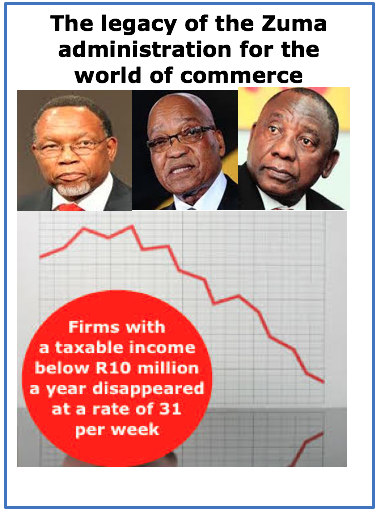
  • firms with a taxable income below R10 million decline at a rate of 31 per week;
  • a mere 635 companies are responsible for 77% of company tax;
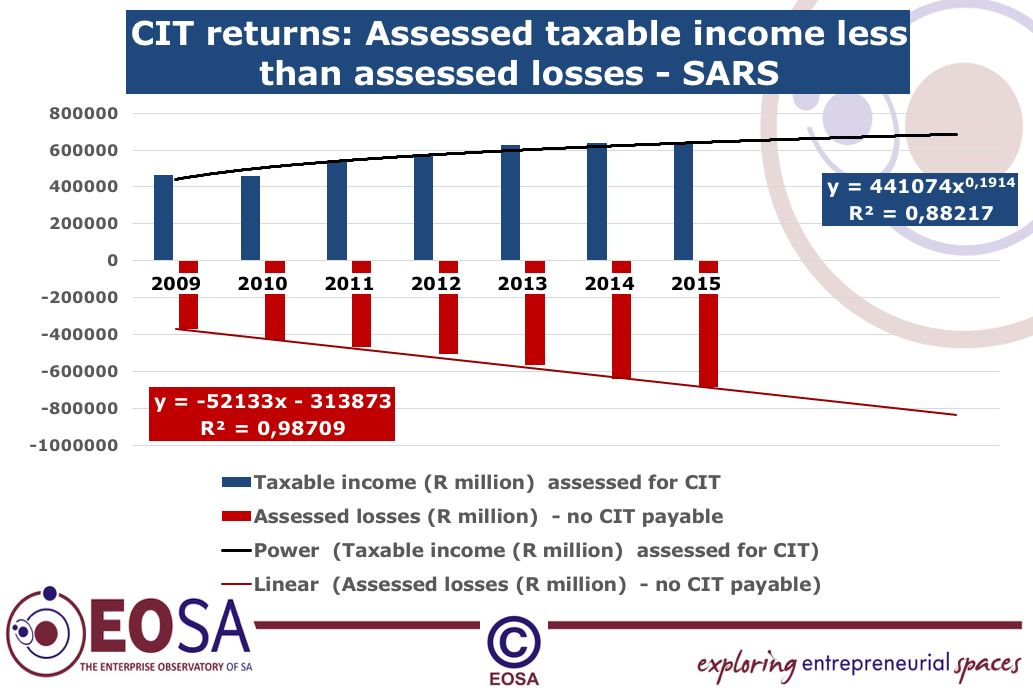
  • from 2009 to 2015 company losses as submitted to SARS increased by 85% and for the last two years were higher than the taxable income assessed.
Screen Shot 2018-04-23 at 9.33.31 AM

SARS data for tax years 2009 to 2015 (for the latter 95.4% of company tax returns have been assessed) as indicators for the health of the South African enterprise landscape, show the business devastation of the Zuma administration (5 with Motlanthe and 4 with Ramaphosa as deputy). This administration, responsible for mismanaging the macro-environment and overseeing the collapse of the police force and education quality and a rise in crime and corruption, critically damaged the enterprise environment.

Continue reading “Investment ambassadors can try, but SA company losses exceed taxable income”

State Capture disguises the devastation by anti-business policies: Bafana-Bafana fared better than the economy

The anger because of billions lost through corruption and state capture comes at an enormous opportunity cost. The focus on the Zuma-Gupta-axis acts as blinkers that prevent a focus on the massive cost of adhering to failing economic policies and strategies – a cost far greater than the billions swindled away through corruption.

Three figures show clearly that the economic malaise is much deeper than the damage caused by corruption parasites and that the impact of poor policies started long before corruption landed under Government privilege at Waterkloof. Blaming the economic ills of South Africa on State Capture is a massive over-simplification.

Continue reading “State Capture disguises the devastation by anti-business policies: Bafana-Bafana fared better than the economy”