Enterprise policies as untested as the practice of bloodletting: no wonder they fail (1)

Johannes Wessels
@johannesEOSA1

More than 3000 years the practice of bloodletting was applied to cure a range of illnesses: intense headaches, constipation, abdominal pain, boils or fever… It was administered by barbers (they had sharp blades) and later by qualified doctors. Some of the famous who received this treatment were Marie Antoinette (when giving birth in 1778 to her daughter Marie-Therese) and George Washington in 1799 on the day of his death when doctors drew about 40% of his blood in an attempt to cure him from a severe throat infection.

In Washington’s case one can only wonder to which extent the bloodletting had contributed to his death. In 1793 acute bloodletting by guillotine definitely caused the demise of Marie Antoinette.

Why did the bloodletting practice with its origins in ancient Egypt continue until a century ago as an esteemed medical practice? Two reasons:

  • The existing paradigm considered bloodletting successful, elevating it to the realm beyond questioning or doubt. It was practised by all the trained practitioners. It was therefore not questioned. Respect for specialist insistence on accepted practice re-enforces paradigmatic reign. Even after the description of the circulatory system by William Harvey in 1628 it took three centuries before the practice of bloodletting was largely abandoned as an unproven cure. One of the most striking examples of this blind acceptance of so-called “expert opinion” is the 1500 years that Greek physician Galen’s doctrines were revered. Galen said of one of his cures: “All who drink of this remedy recover in a short time, except those whom it doesn’t help who all die. It is obvious that it fails only in incurable cases.
Screen Shot 2018-06-02 at 9.41.29 PM
Continue reading “Enterprise policies as untested as the practice of bloodletting: no wonder they fail (1)”

Investment ambassadors can try, but SA company losses exceed taxable income

Johannes Wessels
@johannesEOSA1

Pres Ramaphosa’s announcement that four special ambassadors – including well respected Trevor Manuel – are to roam the globe in an aggressive pursuit of foreign investment  “… like a pack of lions”, appears to be premature. It would have helped these ambassadors if they could have had a better story to tell than one of a business environment with stagnating profitability and growing losses where:

  • only 25% of firms have earned sufficient to be liable for company tax;
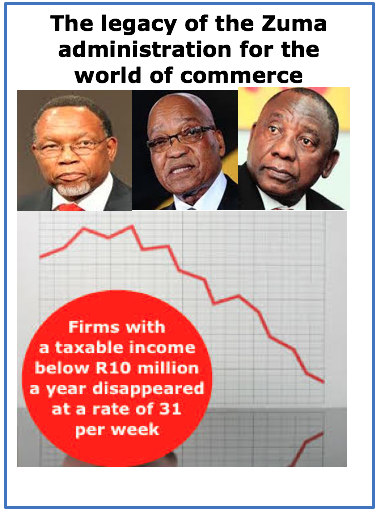
  • firms with a taxable income below R10 million decline at a rate of 31 per week;
  • a mere 635 companies are responsible for 77% of company tax;
  • from 2009 to 2015 company losses as submitted to SARS increased by 85% and for the last two years were higher than the taxable income assessed.
Screen Shot 2018-04-23 at 9.33.31 AM

SARS data for tax years 2009 to 2015 (for the latter 95.4% of company tax returns have been assessed) as indicators for the health of the South African enterprise landscape, show the business devastation of the Zuma administration (5 with Motlanthe and 4 with Ramaphosa as deputy). This administration, responsible for mismanaging the macro-environment and overseeing the collapse of the police force and education quality and a rise in crime and corruption, critically damaged the enterprise environment.

Continue reading “Investment ambassadors can try, but SA company losses exceed taxable income”

The resilience of some small towns in the Karoo

A new article in the Journal of Arid Environments (see reference below) examines the ‘Small Town Paradox’ in eight small towns in the Eastern Cape Karoo. Normalised data (enterprise numbers per thousand residents) and estimates of enterprise richness were used in the comparisons. Willowmore, Steytlerville and Jansenville outperformed Aberdeen, Hofmeyr, Steynsburg, Venterstad and Pearston in terms of total enterprises per 1000 residents as well as enterprises per 1000 residents in the tourism & hospitality services and agricultural products and services sectors. In fact, in some measures these towns even outperformed the larger towns of Graaff-Reinet, Cradock, Somerset East and Middelburg. Over some seven decades, the enterprise richness of Willowmore, Steytlerville and Jansenville increased (like those of the larger towns) whereas the enterprise richness of the other five small towns decreased. Hausmann et al. (2017) postulated that productive knowledge is a main determinant of the wealth/poverty of nations. I think this is also true for towns and used enterprise richness as a proxy for the levels of productive knowledge in the towns.

The resilience of towns is now a hot scientific topic. It refers to the ability of towns to respond successfully to adverse changes. Some do it well and some not; hence the ‘Small Town Paradox’. The decline of agriculture, particularly wool farming, in the Karoo stressed many Karoo towns. The study was done to determine if resilience was present in the Eastern Cape Karoo. It was.

The article demonstrates two important issues: 1. There are useful measures whereby the strengths/weaknesses of the entrepreneurial development of South African towns can be compared. 2. Productive knowledge is probably an important component of the resilience of South African towns.

References

Toerien, DF (2018) The ‘Small Town Paradox’ and towns of the Eastern Cape Karoo, South Africa. Journal of Arid Environments. Available free of charge for a limited period at:
https://authors.elsevier.com/a/1WwV0Vu7-m4sz

Hausmann, R, Hidalgo, CA, Bustos, S, Coscia, M, Chung, S, Jiminez, J,  Simoes, A & Yildirim, MA. (2017) The Atlas of Economic Complexity: Mapping Paths to Prosperity. Center for International Development, Harvard University.

The other side of the ‘tourism coin’

The 2015 Statistics South Africa report on tourism1 concentrates on information about travellers, e.g. their numbers and origins, but does not provide any information about tourism and hospitality (T&H) enterprises in South Africa, e.g. their numbers or locations. Neither do the 2015/16 Annual Report of the Department of Tourism2 and the 2016 Report of the World Tourism Organization3 provide such information. Something is lacking in the tourism scene of South Africa.

Continue reading “The other side of the ‘tourism coin’”

Is a pro-poor LED stance justified?

Nel and Rogerson (2016) reviewed Local Economic Development (LED) policy and practice in South Africa. They reported that results have been modest despite the significant support for nearly 20 years put into applied local economic development. They suggested that a potential over-focus on pro-poor local economic development at the expense of simultaneously working with the private sector on pro-market interventions, could be a stumbling block to the potential success of LED.

Mason (2018) stated that poverty is a multifaceted phenomenon and the condition of poverty often entails one or more of these realities: a lack of income (joblessness); a lack of preparedness (education); and a dependency on government services (welfare).

I asked if our research on enterprise dynamics that reported a wide range of regularities in the enterprise structures and dynamics of South African towns and municipalities (some of which have already been discussed here) could help to shed light on a question whether a pro-poor LED stance might be justified.

Continue reading “Is a pro-poor LED stance justified?”

The economic consequences of Luther: Ideas have legs, but some come with leg-irons

Johannes Wessels
@johannesEOSA1

500 Years after Martin Luther hammered his 95 theses to a church door in Wittenburg, Davide Cantoni, Jeremiah Dittmar and Noam Yuchtman saved their theses to the internet: Beliefs have economic consequences.

Old news, one might say, recalling Weber. But Weber’s thesis was always contested: assumptions of cultural traits based on unreliable statistics from the 19th C. Cantoni, Dittmar and Yuchtman (further-on Cantoni and co.) offer hard micro-statistical evidence from the century when Luther protested against Papal authority : 1517 was a watershed year in how people viewed the world and those (world)views had economic consequences.

In a National Bureau of Economic Research Working Paper of October 2017 they state: “the pre-Reformation era can be understood as an equilibrium in which a monopolist religious producer (the Catholic Church) provided political legitimacy to secular authorities at a high price—charged in the form of control over resources, tax exemptions, and some degree of political power. The Reformation represented a competitive shock in the market for salvation. Protestant reformers offered a popular, lower-cost alternative to the Catholic Church… This had implications for the allocation of resources between secular and religious uses…

Continue reading “The economic consequences of Luther: Ideas have legs, but some come with leg-irons”